Did you know that when a dog smells your private area, it isn’t being rude at all, but is actually detecting complex chemical signals?
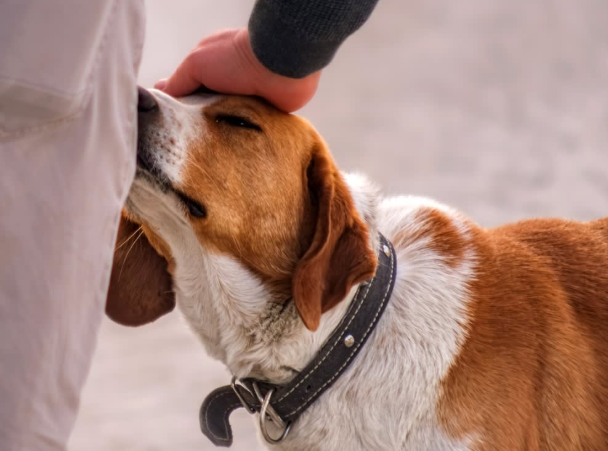
In the complex world of canine perception, a dog’s nose is not just an accessory; it is a powerful gateway into the chemical landscape of everything they encounter. While humans rely mostly on sight and sound, dogs experience life primarily through scent. One of the most common—and often awkward—moments between people and their dogs happens when a dog suddenly directs its nose toward a person’s private area. To us, this can feel embarrassing or impolite. To the dog, however, it is a normal and highly informative way of gathering information. Rather than being rude, this behavior is instinctive, shaped by biology, evolution, and an advanced sensory system that interprets details we cannot perceive.
To understand this, it helps to look at the remarkable structure of a dog’s nose. Humans have about six million scent receptors; dogs can have up to 300 million. This difference makes their sense of smell dramatically more sensitive than ours. When someone walks into a room, a dog does far more than notice a general scent. They detect hormonal changes, dietary differences, emotional shifts, and even subtle variations in health. Part of this ability comes from the vomeronasal organ—also called Jacobson’s organ—located between the nasal passages and the roof of the mouth. This structure specializes in detecting pheromones, the chemical signals that communicate social and biological information. For a dog, a single sniff can reveal an astonishing amount of detail.
The reason certain areas of the body receive extra attention relates to sweat glands. Humans have two main types: eccrine glands, which produce watery sweat for cooling and are spread across most of the body, and apocrine glands, which produce a thicker, protein-rich secretion. Apocrine glands are concentrated in places such as the armpits and groin. When natural skin bacteria break down these secretions, they release distinct chemical compounds. To a dog, these regions are especially rich in information. By sniffing there, they are effectively reading a person’s “chemical profile,” learning about biological sex, age, emotional condition, and changes occurring within the body.
Dogs are particularly sensitive to hormonal shifts that occur during menstruation, pregnancy, or after childbirth. Each of these states subtly alters a person’s scent signature. Changes in testosterone levels or metabolism can also affect how someone smells to a dog. From an evolutionary standpoint, this skill was essential for their ancestors. In pack life, scent communicated hierarchy, reproductive status, and group membership. While humans rely on language and social norms, dogs still depend heavily on this ancient chemical communication system.
This powerful sense of smell also explains why dogs can perform impressive medical detection tasks. Some are trained to recognize certain cancers, detect drops in blood sugar for people with diabetes, or alert before an epileptic seizure. Because areas rich in sweat glands often reflect internal chemical changes, a dog may focus attention there if they notice something different from a person’s usual scent. What seems random to us may simply be the dog detecting a new or unusual chemical signal.
Despite the clear biological explanation, human reactions are usually embarrassment. In canine social behavior, sniffing is a standard greeting. When a dog applies this same approach to a human, they are not trying to violate social rules; they are following instinct. Managing the behavior is best done through calm redirection. Instead of scolding or pushing the dog away—which can create confusion—owners can guide the dog toward a more appropriate behavior, such as offering a hand to sniff or using familiar commands like “sit” or “leave it.” Rewarding compliance reinforces the idea that while sniffing is natural, human interactions have different boundaries.
Dogs’ sensitivity to scent also strengthens their emotional connection with people. Stress hormones such as cortisol and adrenaline alter body chemistry, and dogs can detect these changes almost immediately. They may respond by becoming alert, anxious, or comforting. This chemical awareness deepens the human–canine bond. Often, a dog senses how someone feels before any outward sign is visible.
Some misunderstandings surround this behavior. It is not limited to poorly trained or unneutered dogs, nor is it necessarily about dominance. Curiosity driven by scent is universal among dogs. It is also not inherently sexual. To a dog, pheromones are simply pieces of information about identity and condition, not signals wrapped in human ideas about attraction.
Understanding why dogs sniff private areas can turn an awkward encounter into a moment of appreciation. It highlights the extraordinary sensory world dogs inhabit—a world built from molecules, hormones, and subtle biological cues. When a dog investigates your scent, it reflects curiosity and recognition, not judgment.
By acknowledging this instinct while gently teaching appropriate behavior, we can balance personal comfort with respect for canine nature. The next time a dog seems overly curious, remember that they are exploring the world in the way they were designed to do. Their nose is their primary tool for connection, understanding, and communication.