Joke of the Day: The Hidden Meaning Behind a Southern Belle’s Polite Smile and a Mother’s Eye-Opening Lesson
This story offers a timeless look at the humor and irony woven into Southern manners and the amusing ways family loyalty can blur our judgment. It shows how a graceful exterior can conceal sharp wit—and how the same behavior can be viewed very differently depending on who is involved.
The Art of Refined Conversation
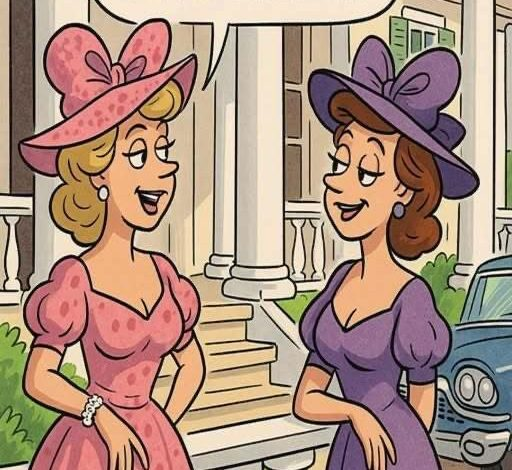
Picture yourself relaxing on a wide porch of an elegant mansion with tall white columns. I was visiting my friend Margaret, who seemed determined to list her life’s accomplishments as though she were keeping score.
As we sat together, she motioned toward the impressive home around us. She explained that when her first child was born, her husband had built the entire house as a special gift for her. I took a slow sip of my drink and replied calmly, “Well, isn’t that nice.”
She continued by pointing to a sleek, new Cadillac in the driveway. That, she said, was her reward for having her second child. I smiled politely and answered, “How lovely.”
Next, she proudly displayed a glittering diamond bracelet she received after her third child arrived. Holding up her wrist, she clearly expected admiration—or maybe even envy. She wanted a stronger reaction than I gave. Once again, I simply glanced at it and said, “Well, isn’t that nice.”
A Lesson in Charm
At last, Margaret grew frustrated. She couldn’t understand why her luxuries failed to impress me. Leaning closer with a playful smirk, she asked, “So what did your husband give you when you had your first child?”
I returned her look with a gentle smile and replied, “He sent me to charm school.”
She stared at me in confusion. “Charm school? Why would you want that instead of a house or jewelry?”
Laughing softly, I decided to be honest. Looking straight at her, I said, “So instead of saying, ‘Who gives a crap,’ I learned to say, ‘Well, isn’t that nice.’”
For the first time all afternoon, Margaret was speechless. Sometimes, the most valuable gift isn’t something you can drive or wear—it’s the ability to hide your true thoughts behind a polite smile.
The Double Standard of Family
As the day went on, our conversation shifted to our grown children. Margaret’s mood changed when she began talking about her son’s marriage. She called it a complete disaster.
She complained that her daughter-in-law was terribly lazy, claiming she did no housework and spent most of her time in bed reading. What bothered her most was that her son brought his wife breakfast on a tray every morning. She spoke as if he were being taken advantage of.
I listened quietly, waiting for her to mention her daughter, who had also recently married.
When she finally did, her face brightened instantly. She described her son-in-law as an “angel” and a “perfect husband.” She was delighted that he insisted her daughter never do chores and encouraged her to sleep as long as she liked.
And every morning, without fail, he brought her breakfast in bed so she could relax.
A Matter of Perspective
The realization was striking. Margaret was describing the same behavior in two different people—yet judging it in completely opposite ways.
When her daughter-in-law stayed in bed and received breakfast, she was labeled lazy. When her daughter did the same, her husband was praised as a saint.
It became obvious: in family dynamics, people are often called “wonderful” or “useless” not because of what they do, but because of whose child they married. In the end, perspective truly changes everything.